
System Architecture Diagram
End-to-end request flow from the dashboard through security, intent routing, command generation, remote execution, and audit logging.
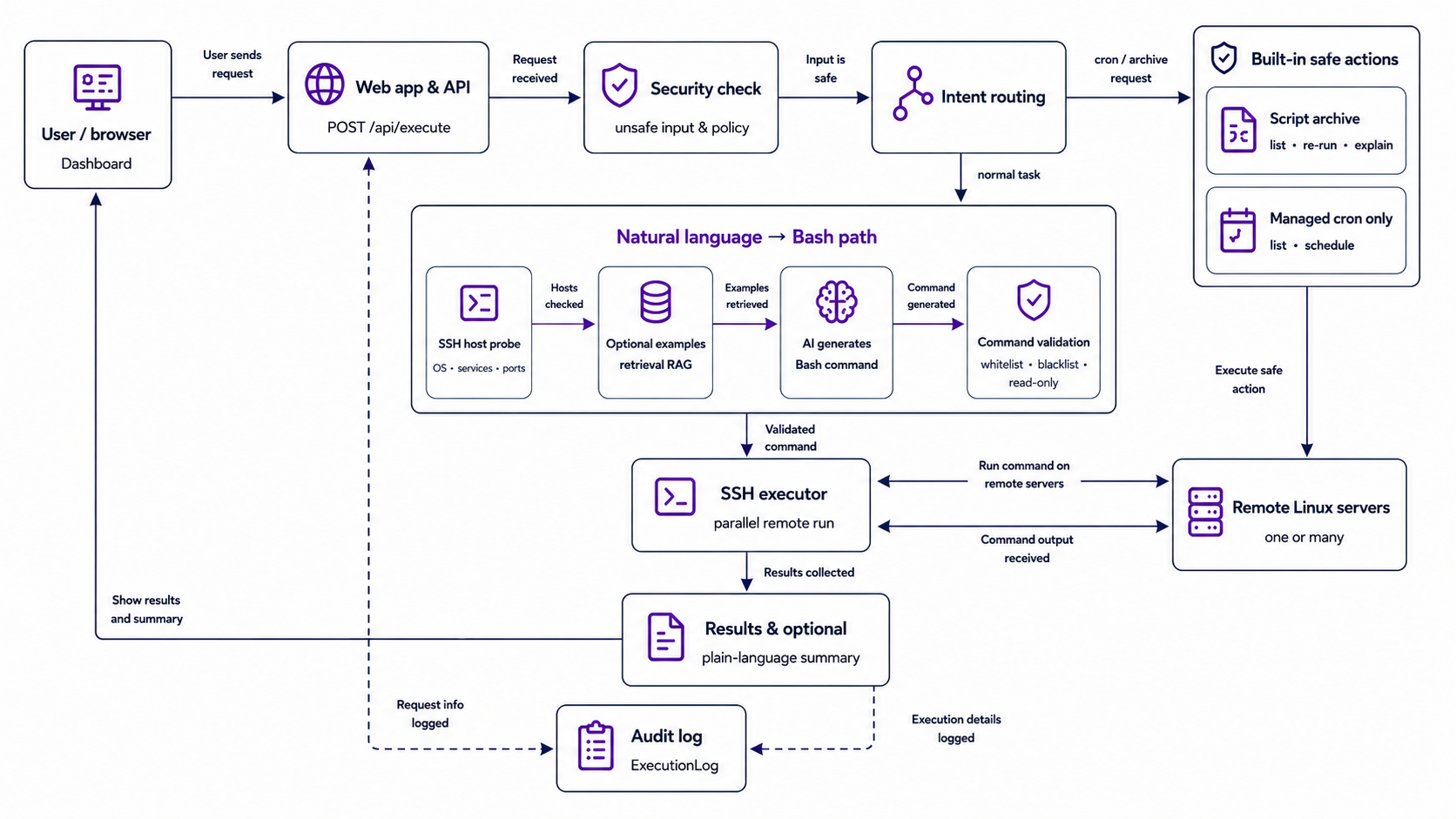
Interactive Workflow
-
1. Authentication
Session-protected access ties actions to signed-in users for accountability.
-
2. Request and targets
Users submit a natural language task and optionally select servers; otherwise configured defaults apply.
-
3. Input security validation
The security layer screens unsafe patterns and policy violations before any routing or generation.
-
4. Intent routing (safe modes)
Safe Cron intents (list or schedule managed entries) and Script Archive intents (list, rerun, explain) short-circuit to dedicated SSH helpers when matched.
-
5. Host probe and RAG
For standard NL-to-Bash, each host is probed in parallel for OS, services, and sockets; trusted examples may be retrieved to ground the LLM prompt.
-
6. LLM generation and cleanup
An OpenAI-compatible model proposes commands per host context; markdown wrappers and unsafe prompt leakage are stripped.
-
7. Command validation
Whitelist, blacklist, read-only rules, and normalization gate execution and shape the final command string.
-
8. Parallel SSH execution
Paramiko runs approved commands independently per host; multi-line scripts are archived remotely before execution when applicable.
-
9. Reporting and audit
Structured JSON includes summaries and technical reports, optional AI explanations, and persistent execution logging for review.